Articles
Where Do I Report This? Designing Government Services So People Don’t Have to Find the Answer Themselves
The challenge may be to make separate systems feel like one
The Ministry of Digital Economy and Society held Digital Shield Learning Fest 2026 on 15–16 August 2026 under the theme “Safe Digital Journey: Learn Before Entering the Digital World”. The event aimed to help people protect themselves and build digital literacy. This means going beyond teaching people how to use technology. It means building safe, mindful online habits and a culture of thinking before using, believing or sharing information.
That raises another question. Once people know what digital threats look like, what happens when they face one anyway? They might be tricked into transferring money or making an investment, have personal information stolen, come across a fake website or page, or suspect a data leak. Their first question may be as much about where to report the problem as about how to solve it. Should people really have to know which agency is responsible?
People shouldn’t have to know which agency to contact
Government agencies already operate several channels for reporting problems, lodging complaints and asking for help, with different agencies responsible for different issues. For most people, working out who is responsible and which system to use can be hard. By the time they find the right contact, the problem may have become more complicated. Some may give up on reporting it altogether because they do not know where to start.
Well-designed digital public services should be accessible without making people learn how government is organised. When we use Google Maps, we do not have to know who manages each road or how routing works behind the scenes. We say where we want to go, and it finds a route. Contacting government should work in much the same way. People should be able to report a problem in one place. The government can then use its systems to identify the responsible agency and forward the report to it.
Separate systems can still feel like one service
Many countries aim to provide a single point of contact for reporting issues to government. South Korea has e-People, and China has the nationwide 12345 hotline. For Thailand, the question may be how to connect the systems that agencies already have so they work together as one service. Agencies have their own mandates, reporting systems, databases, laws and processes. A single point of entry with connected agency systems behind it, or “One Front Door + Federated Back Offices”, lets the public use one door while each agency keeps its own back office. Replacing all existing systems would carry substantial costs in time, funding, legal changes, responsibilities, data integration and agency adoption.
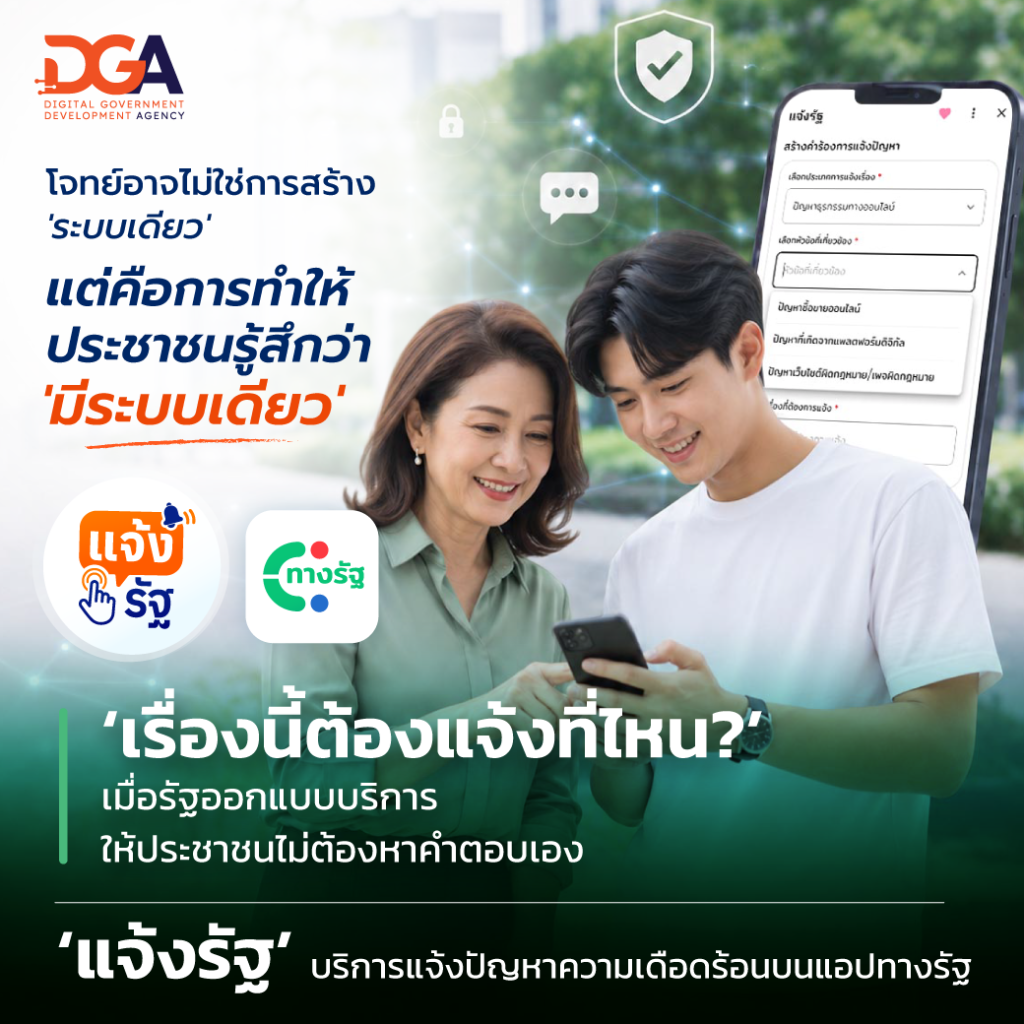
This idea led DGA to develop Report an Issue in the Thang Rath app. It gives people one place to report problems to different agencies. Whether the issue is an online threat, an online purchase, an illegal website or page, or an investment scam, people can explain what happened, select the issue type and provide details. The system then forwards the report to the responsible agency.
The service is already available in Thang Rath, starting with online issues. It connects to the National Cyber Security Agency for fake websites or accounts, the Electronic Transactions Development Agency for issues with online marketplaces, and the Royal Thai Police for online crime. Police integration began with tracking cases already filed with the Cyber Crime Investigation Bureau, with new reports planned for a later phase. The Securities and Exchange Commission is preparing to accept investment-scam reports through the service. DGA has also extended it to some everyday issues, including complaints about public services through the Public Sector Anti-Corruption Commission, social welfare grievances through the Ministry of Social Development and Human Security, disasters through the Department of Disaster Prevention and Mitigation, and local problems through local authorities.
The next step is to connect more agency systems, including Traffy Fondue, used by the Bangkok Metropolitan Administration and other agencies, and channels run by consumer protection, insurance, broadcasting and telecoms, and personal data protection authorities. Other candidates include the Damrongdhama Centre (1567) and the government’s 1111 service. DGA is proposing to the Office of the Permanent Secretary of the Prime Minister’s Office that Thang Rath’s Report an Issue become another route into 1111. When the systems connect, people can start in one place while the government handles the complexity behind the scenes. The service can then become a link between the public and existing government reporting systems.
From receiving reports to seeing problems across the country
Each agency may see only the issues within its own area or remit. Bringing scattered reports together could help the government see which problems people face, where they occur, how common they are and which are increasing. Connected data supports better decisions. AI could also help identify trends and early warning signs, so agencies can prepare before problems become widespread.
Rather than relying only on impressions, news reports or the voices of a single group, agencies can use report volumes, frequency, locations and trends to set priorities, allocate resources, improve services and track progress. That would support a more data-driven government. In future, publishing aggregate statistics could also help the public understand the problems the country faces.
For the public, Report an Issue should make asking the government for help simpler. People should only need to explain the problem. Making that possible requires policy support, shared standards and sustained cooperation among the agencies that operate the different reporting systems.
That is the challenge for Thailand: how can the systems already in place work together as one service?